Tuesday, September 18, 2012

Call the Midwife by Jennifer Worth


Call the Midwife by Jennifer Worth
The Midwife Trilogy, Book 1
Publisher: Weidenfeld & Nicolson (January 2010)
279 pages, Paperback (purchased myself in an omnibus edition for $11.99)
Book Rating: 5 Stars

This is Jennifer Worth’s memoir of life as a midwife in London’s East End in the 1950’s. This story was not only interesting, but also very entertaining, and provides a look at 1950’s midwifery, the culture of the East End and a way of life that is now gone. The collection of anecdotes about patients, nuns, fellow midwives, and East End culture are threaded together in a seamless presentation that is at times poignant and others hilarious. It is worth noting that this book is the first book in a trilogy, followed by Shadows of the Workhouse and Farewell to the East End. Also, if you are watching the TV series currently airing on PBS, that TV series contains stories from all three books in the trilogy and is not confined to the content from the first book. Highly recommended read!


Movie Adaptations/Modern Retellings/Related Works:
Call the Midwife (TV Series 2012-)
Vanessa Redgrave, Jessica Raine, Bryony Hannah

My Rating: 3 Stars
Adaption: Verbatim-Tweaked-Veiled
Eye Candy: Plain-Pretty-Sultry

Saturday, August 18, 2012

A Whole New Mind by Daniel H. Pink


A Whole New Mind by Daniel H. Pink
Publisher: Riverhead (March 2006)
294 pages, Audiobook (purchased myself for $4.99)
Book Rating: 5 Stars

For the past few decades, the modern workforce centralized around people who excelled at left brained activities. But due to abundance, automation, and cheap labor overseas, the modern workforce will have to excel at both left and right brain activities. This is the central argument in Daniel Pink's book A Whole New Mind. 

In the first section, Daniel Pink outlines the current migration from the knowledge age to the conceptual age by contrasting left and right hemisphere thinking, arguing that cheap foreign labor and software is devaluing left hemisphere and increasing the importance of whole minded (right and left brain) thinking. 

The second half is focused on what Mr. Pink calls the six senses, aptitudes that are essential to compete in the conceptual age:  design, story, symphony, empathy, play, and meaning. A chapter is devoted for each aptitude.  At the end of each chapter a portfolio is provided with exercises and resources. 

A Whole New Mind is an intelligent, but simplified look at the changes coming in our future economy. It's raising an important flag in a world that still over values science and engineering, and looks down on the liberal arts.

The Frontiersmen by Allan W. Eckert


The Frontiersmen by Allan W. Eckert
Winning of America Series, Book 1
Publisher: Jesse Stuart Foundation (August 2011)
652 pages, eBook (purchased myself for $9.99)
Book Rating: 5 Stars
Content Note: Includes Mild Sexual Content and Violent, Gruesome Battle Scenes

Beginning in 1755, with the birth of this story’s central character, Simon Kenton, and ending with his death in 1836, this is a non-fictional history told in the style of a novel, following three main characters (Simon Kenton, Blue Jacket and Tecumseh) and their exploits in the Ohio, Indiana and Kentucky wilderness from 1768 through the resolution of the Battle of 1812. The story is told from both the viewpoint of the Frontiersmen and the Shawnee Indians. Other notable characters such as Daniel Boone also play a large part. The story is presented in such a compelling way, that I will never again think of history as a dry subject and I had no problem at all making my way through this large book. I appreciated that all major and minor characters featured in the book either met their resolution in the course of the story or in the following epilogue, so I wasn’t left wondering what happened to anyone. This is an excellent book and I look forward to reading other books in this Winning of America series!

Monday, August 13, 2012

White People, Indians and Highlanders by Colin G. Calloway


White People, Indians and Highlanders by Colin G. Calloway
Publisher: Oxford University Press, USA (July 2008)
391 pages, eBook (purchased myself for $13.72)
Book Rating: 5 Stars

This book is about the similarities in culture and history of the Scottish Highlanders and the Native Americans, particularly the commonalities of their interactions with the English, the removal from their homelands and the decline of their cultures as they knew it. An interesting look at events and perspectives usually left out of most history books. While there are obvious differences between the two cultures and their historical experience, the similarities are astounding and very thought provoking. There is also a bit of commentary at the end regarding the significance of modern day people identifying with ones ancestry or heritage; idealized, romanticized or real. Interesting read!

Friday, August 10, 2012

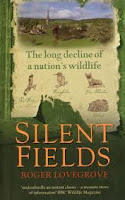
Silent Fields by Roger Lovegrove


Silent Fields by Roger Lovegrove
Publisher: OUP Oxford (September 2008)
415 pages, eBook (purchased myself for $16.47)
Book Rating: 4 Stars

This is the story of the decline in both abundance and diversity of the wildlife of Britain, in the name of safety, in the name of food source and game preservation, in the name of fashion and in the name of entertainment through sportsmen with a passion for hunting, trapping and collecting, but also due to environmental and land use changes through history. This isn't exactly typical pleasure reading material; this is a scholarly work, with lots of statistics, charts and exploration of minutiae, but if you have an interest in the subject matter, this is an invaluable resource. The historical and political events that led to the Scottish Highlands being something of a last frontier with regard to wildlife and wilderness and the events that led to its eventual exploitation, I found very interesting. If you have an interest, this is an excellent read!

The World Without Us by Alan Weisman


The World Without Us by Alan Weisman
Publisher: Picador (August 2008)
432 pages, Paperback (purchased myself for $10.20)
Book Rating: 5 Stars

A fascinating look at what would likely become of the world if humans as a whole were to suddenly disappear. The conclusions are based on what has happened to small areas of the world that have been abandoned for one reason or another, as well as scientific research and observations of the natural world. Without our interference, it appears the world would largely return to its natural state relatively quickly, with a few exceptions. What is expected to remain from our civilization long term, isn’t  in most cases, what we would wish to be remembered for. The thoughts on the downfall of the Mayan civilization being caused by their society getting too removed from basic necessities, definitely gave me something to ponder. Thought-provoking read!

Tuesday, August 7, 2012

Imagine: How Creativity Works by Jonah Lehrer


Imagine: How Creativity Works by Jonah Lehrer
Publisher: Houghton Mifflin Harcourt (March 2012)
256 pages, Audiobook (purchased myself for $19.95)
Book Rating: 5 Stars

Creativity has been thought of as a gift to a privileged few. Jonah Lehrer, in his new book "Imagine" tries to dispel that myth.  Using the latest studies in science and psychology, Jonah uses an array of studies and experiences to help describe the creative processes and where it comes from. 

Jonah starts out the first part of his book on looking at the different parts of the creative process and how they all fit together. He first looks at insight, and with the help of the latest research in neuroscience shows how insight is found through the making of new neurological connections which is the primary job of the right hemisphere. 
Insight, however, is not the end of the creativity process. Jonah then goes over how time is an extremely important component to the creative process, and how drugs like Benzedrine could help artists and poets refine their art by allowing them to greatly focus on their art over long periods of time. 

The last part of his book, Jonah writes on how our environment and culture affect our creativity. He cites research on how urban density, if done correctly, helps produce creative ideas. He also looks at how some highly creative companies have changed their work environments to help foster the creative processes discussed earlier in the book. 

Some more empirically driven people might not like Jonah's approach. There are many scientific studies cited in the book, but there is quite a bit of references to experiences and insight from many who do not wear a scientific lab coat. Good ideas can come from anywhere, and Jonah did an excellent job researching this book

Imagine is an insightful and readable book that will help anybody with an open mind better understand creativity and where it comes from.

Note: This book has recently become unavailable through the publisher due to allegations that the author falsified some quotations that were included in the book (specifically quotations attributed to Bob Dylan).